Main Menu
 |
|
Most Favorited Images |
|
Recently Uploaded Images |
|
Most Liked Images |
|
Top Reviewers |
| cockalatte |
650 |
| MoneyManMatt |
491 |
| Jon Bon |
408 |
| samcruz |
400 |
| Still Looking |
399 |
| Harley Diablo |
377 |
| honest_abe |
362 |
| George Spelvin |
352 |
| Starscream66 |
318 |
| DFW_Ladies_Man |
313 |
| Chung Tran |
288 |
| lupegarland |
287 |
| nicemusic |
285 |
| You&Me |
281 |
| sharkman29 |
270 |
|
|
Top Posters |
| biomed1 | 72067 | | DallasRain | 71689 | | Yssup Rider | 64516 | | gman44 | 56332 | | offshoredrilling | 51065 | | LexusLover | 51038 | | WTF | 48272 | | bambino | 48236 | | pyramider | 46457 | | The_Waco_Kid | 42155 | | Dr-epg | 40814 | | CryptKicker | 37478 | | Mokoa | 36518 | | Chung Tran | 36100 | | Still Looking | 35944 |
|
|
 01-17-2026, 02:37 AM
|
#16
|
|
Valued Poster
Join Date: Aug 7, 2010
Location: OPKS
Posts: 7,761
|
Quote:
Originally Posted by Precious_b

I wanted you to be clear since they are both different class carriers. But you neglected to say if the Enterprise was able to bear all reactors power output to the shafts.
And I was not comparing them. I was using them as an example of fluid dynamics and the drag efficiencies. Or loss of trying to push things faster. There definitely is a point of diminishing returns with a given hull design.
Amazes me these big aircraft carriers can shit-n-get that fast.
|
The reactors don't put power directly to the shafts. The reactors boil water creating steam for turbines that turn the propellers. You could have all the reactors full bore but it's limited by the power of the steam engines.
|

|
Quote
 | 1 user liked this post |
|
01-17-2026, 03:32 AM
|
#17
|
|
Valued Poster
Join Date: Apr 8, 2013
Location: houston, tx
Posts: 10,952
|

^^and what's harder, building a new ship or replacing spent nuclear fuel..
why the Nimitz should not be decommissioned:
1. Strategic Deterrence and Presence Still Matter More Than Marginal Savings
Aircraft carriers are not just weapons platforms; they are mobile sovereign territory. The Nimitz provides persistent, visible deterrence that cannot be replicated by submarines, long-range bombers, or missiles alone.
A carrier strike group signals commitment, not just capability.
Forward-deployed carriers reduce escalation risk by providing flexible response options short of war.
Decommissioning reduces the U.S. Navy’s ability to maintain continuous presence in multiple theaters (Indo-Pacific, Middle East, Europe).
At a time of increased great-power competition—especially with China—shrinking visible force posture invites testing and miscalculation.
2. Fleet Size Is Already at the Lower Bound of Credible Global Coverage
The U.S. Navy is already struggling to meet Combatant Commander demand with its current carrier inventory.
The statutory goal is 11 operational aircraft carriers.
Maintenance delays and extended overhauls routinely reduce the number actually available.
Removing Nimitz without a fully operational replacement creates a real capability gap, not a theoretical one.
This is not a one-for-one swap problem; carriers take years to build, certify, and integrate into fleet operations. Early decommissioning creates irreversible near-term risk.
3. The Nimitz Remains Militarily Relevant with Modern Air Wings
While the hull is old, the combat power of a carrier resides primarily in its air wing and networks, not the ship’s age.
Modern aircraft (F/A-18E/F, EA-18G, E-2D, and potentially F-35C integration) dramatically extend lethality.
Upgraded command, control, and ISR systems allow legacy carriers to operate effectively in networked warfare.
The ship remains nuclear-powered, giving it endurance advantages over conventionally powered alternatives.
The argument that Nimitz is “obsolete” conflates platform age with combat irrelevance, which is not supported by operational reality.
4. Decommissioning Sends the Wrong Signal to Allies and Adversaries
Naval force structure decisions are strategic communications, whether intended or not.
Allies interpret early decommissioning as declining U.S. commitment.
Adversaries interpret it as waning political will to sustain global presence.
The timing—amid heightened Indo-Pacific tensions—magnifies that signal.
Deterrence depends not just on weapons, but on credibility and consistency.
5. Cost Arguments Are Often Overstated and Poorly Contextualized
While operating a nuclear carrier is expensive, the marginal savings from early decommissioning are frequently exaggerated.
Decommissioning itself is costly, particularly for nuclear vessels.
Savings are modest compared to the overall defense budget.
The cost of losing deterrence or failing to respond to a crisis dwarfs annual operating costs.
Strategic assets should not be evaluated using narrow peacetime accounting logic.
6. Risk of Over-Correction Based on Unproven Future Concepts
Much of the push to retire legacy carriers rests on assumptions about future warfare:
That long-range missiles will make carriers unusable
That unmanned systems will soon replace carrier aviation
That distributed lethality can fully substitute for concentrated power
These concepts are not yet mature. Retiring proven capability before replacements are fully operational is a classic case of strategic over-correction.
7. Institutional Knowledge, Training, and Surge Capacity
The Nimitz is not just a ship; it is a training platform and surge asset.
Maintains carrier pilot proficiency and deck crew experience.
Provides operational depth in case of unforeseen conflict.
Reduces stress on newer carriers and maintenance cycles.
Once decommissioned, this capacity cannot be rapidly regenerated.
Bottom Line
Decommissioning the USS Nimitz prematurely would:
Reduce U.S. global deterrence
Create real, near-term capability gaps
Save relatively little money
Signal declining resolve to allies and adversaries
Bet national security on unproven future systems
The prudent course is to retain Nimitz until replacement capacity is fully operational, not merely planned.
does new steel beat old steel, actually..
|

|
Quote
| 1 user liked this post |
|
01-17-2026, 04:06 AM
|
#18
|
|
BANNED
Join Date: Jan 8, 2010
Location: The MAGA Zone
Posts: 42,155
|
Quote:
Originally Posted by royamcr
The reactors don't put power directly to the shafts. The reactors boil water creating steam for turbines that turn the propellers. You could have all the reactors full bore but it's limited by the power of the steam engines.
|
don't forget bearing shaft temps. as i stated the reactors can overpower all of the physical machinery.
while we are speaking of nuclear powered watercraft's let's start at the beginning
https://en.wikipedia.org/wiki/USS_Nautilus_(SSN-571)
the one that started it all .. proved the nuke power concept
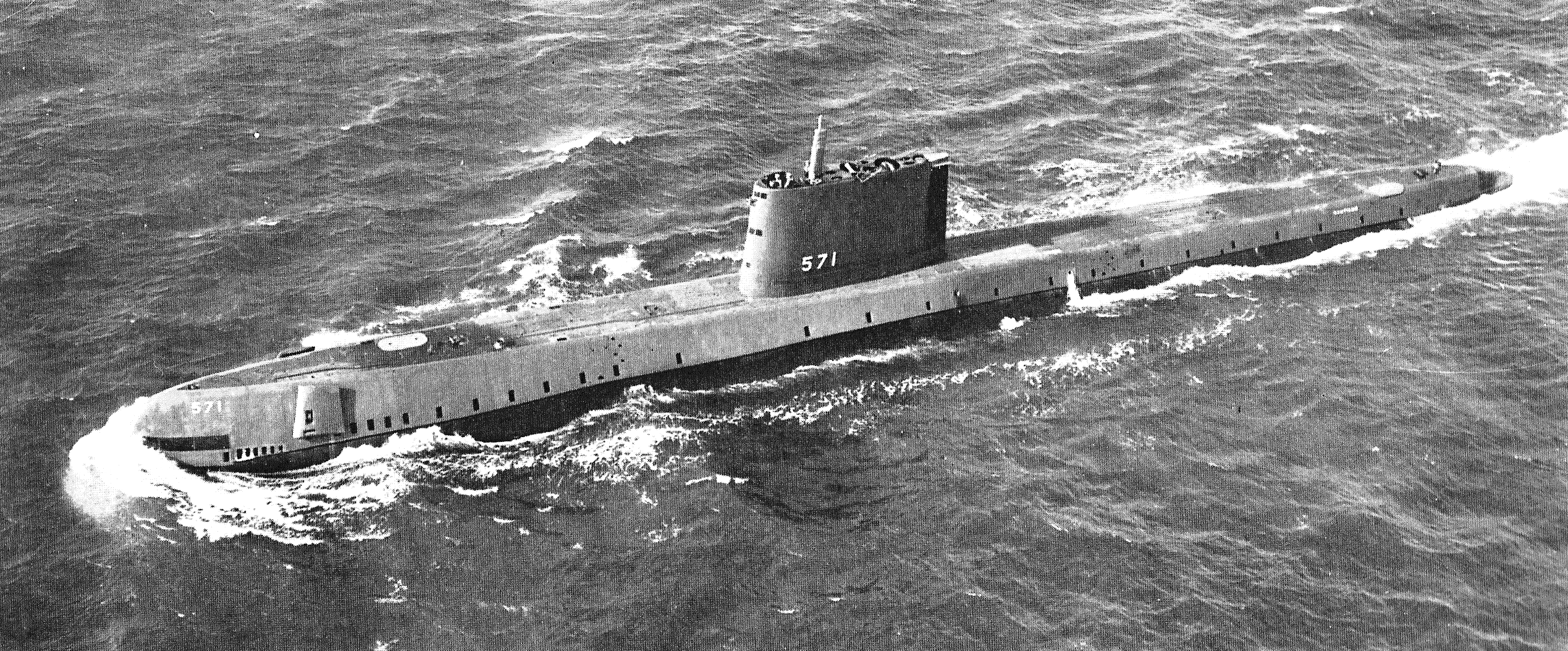
the origin of the nuke sub service and the nuclear powered aircraft carrier
while this was poc nuke concept it was a 6 tube navy combat vessel also by design
the Navy wanted an all nuke Navy. they built 4 cruiser/frigate nuke ships along with the Enterprise. and a Nimitz class the four prototype nuclear Navy
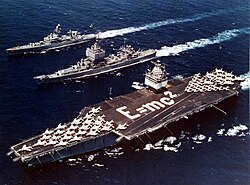
Task Force One, the first nuclear-powered task force. Enterprise, Long Beach and Bainbridge are in formation in the Mediterranean, 18 June 1964. Enterprise has Einstein's mass–energy equivalence formula E= mc² spelled out on her flight deck. Note the distinctive phased-array radars in the superstructures of Enterprise and Long Beach.
and this
 Nimitz
 on her first deployment in 1976 alongside nuclear-powered cruisers California and South Carolina
the Navy had to settle for nuke carriers and subs and conventional warships.
but this is what it could have been.
|
|
|
Quote
| 2 users liked this post |
|
01-17-2026, 04:43 AM
|
#19
|
|
Valued Poster
Join Date: Aug 5, 2010
Location: Houston Area
Posts: 7,270
|
Quote:
Originally Posted by Precious_b
Could the Enterprise put all that extra power to the prop shaft? If so, do you know what the unofficial speed of it was since I don't think they would offer a rated speed.
I was reading about the problems with the power output of engines on the New York class battleships and the studies the engineers did with the Iowa class. It essentially boiled down to diminishing returns. I can't remember the numbers but it sorta mimicked that at a point you had to add 25% more power to just get a couple knots more speed. Crazy.
|
For a non-plaining hull, top speed is limited by the waterline length among other things. There is a formula involving square roots and so on, but overall length is the major controlling factor. Our nuclear carriers are the longest ship in the US Navy and have as much power as cn be delivered as thrust through propellers.
Years ago I worked in a VA hospital. I had the opportunity to talk with Vets all dya long. The top speed of a carrier was a topic I explored. Anecdotally, it seems that a nuclear carrier can out run any other ship in its task force. I am under the impression that at full throttle, 60 MPH is possible.
I would welcome anyone with a solid number to comment.
|
|
|
Quote
| 1 user liked this post |
|
01-17-2026, 05:41 AM
|
#20
|
|
Valued Poster
Join Date: Aug 7, 2010
Location: OPKS
Posts: 7,761
|
Quote:
Originally Posted by pxmcc
^^and how much does a new carrier cost, and how long to build..
|
About 4 times the refuel/refit. But a twice refueled carrier would be 50 years old with old problems. Salt water is very corrosive so I bet there is plenty of rust and worn out parts under all that paint.
|
|
|
Quote
| 1 user liked this post |
|
01-17-2026, 09:14 AM
|
#21
|
|
Valued Poster
Join Date: Aug 5, 2010
Location: Houston Area
Posts: 7,270
|
With the Navy's current emphasis on the concept of "Distributed Lethality", IMHO, they would do better to build a number of smaller carriers as we did in WW-II. I would like to see additional amphibious ships with enhanced capabilities for air assets.
While this might actually cost more in construction, staffing, operations and maintenance, the probability on one catastrophic sinking would be spread out with more targets.
In the 1980s Falklands War, the UK used a container ship to launch Harrier fighter jets. Something like that could be another option.
The Air Force has expanded their strike capability and spread out their vulnerability by weaponizing most of their cargo transports (C-130, C-17 and C-5B). Any platform that can air-drop a pallet of supplies can now deploy a swarm of cruse missiles.
|
|
|
Quote
| 1 user liked this post |
|
01-17-2026, 08:21 PM
|
#22
|
|
Lifetime Premium Access
Join Date: Apr 25, 2009
Location: sa tx usa
Posts: 17,128
|
Quote:
Originally Posted by royamcr
The reactors don't put power directly to the shafts. The reactors boil water creating steam for turbines that turn the propellers. You could have all the reactors full bore but it's limited by the power of the steam engines.
|
I figured that. How else would you operate other needed systems. My question was more of the damn the torpedos, full speed ahead ilk.
Quote:
Originally Posted by ICU 812
For a non-plaining hull, top speed is limited by the waterline length among other things. There is a formula involving square roots and so on, but overall length is the major controlling factor. Our nuclear carriers are the longest ship in the US Navy and have as much power as cn be delivered as thrust through propellers.
Years ago I worked in a VA hospital. I had the opportunity to talk with Vets all dya long. The top speed of a carrier was a topic I explored. Anecdotally, it seems that a nuclear carrier can out run any other ship in its task force. I am under the impression that at full throttle, 60 MPH is possible.
I would welcome anyone with a solid number to comment.
|
My foray into physics and dealing with Bournelli (sp) stopped me from going any further into drag problems of any sort. My hand salute to the engineers who deal with these problems. As I stated for the Dreadnaught class in trying to keep up with the newer ships and the energy they would have to expend to get squat on return.
I can understand the length to width ration in helping with efficiency in speed. Just like those 6 something mm Swedish Mausers and creedmore rounds. Long as crap but very moderate barrel twist. But I digress in the field of sectional density and such. Idk if the design of ships today still have to take into question the ability to go through the two big locks on earth.
Quote:
Originally Posted by royamcr
About 4 times the refuel/refit. But a twice refueled carrier would be 50 years old with old problems. Salt water is very corrosive so I bet there is plenty of rust and worn out parts under all that paint.
|
It is a given that any branch of the military will always go for the more expensive option 
|
|
|
Quote
| 1 user liked this post |
|
01-18-2026, 04:55 AM
|
#23
|
|
Valued Poster
Join Date: Aug 5, 2010
Location: Houston Area
Posts: 7,270
|
^^^
Certainly that is an expectation but not, I think, a "given". What tends to happen is that the military asks for the moon in terms of capability and industry try to develop stuff that gets them there. . . .at a cost of time and money. Often this fails in some way and the process starts all mover aghain.
However, recently the Air Force, faced with a potential shortage of bombers and strike aircraft, went all in on the "Rapid Dragon" system that put a minimal amount of money into developing way to palletize existing cruse missiles and just drop them from cargo aircraft. this could allow them to cancel or reduce the B-21 bomber program and other expensive items.
The Army has wanted a new tank for a decade or so. They wrecked about to go into a deign process for a whole new task . . .a ground up, blank sheet program. Instead, they decided to just re-work the chassis for the current M-1 Abrams with all the advanced stuff they need. This will save billions and short circuit the acquisition by 10 or 15 years.
Meanwhile, a company called Anduril is designing and producing cruse missiles that can be mass produced in high volume and lower cost than the existing high end missiles we get fro Raytheon and other legacy Defense contractors . . .and selling them to Uncle Sam.
In a related lie, SpaceX and a few other private rocket companies are showing that they can out compete with NASA in launch frequency and dollars per pound put into orbit. I do not think the NASA will be able to put an astronaut on the moon before Elon Musk does.
|
|
|
Quote
| 1 user liked this post |
|
01-18-2026, 05:53 AM
|
#24
|
|
Valued Poster
Join Date: Apr 8, 2013
Location: houston, tx
Posts: 10,952
|
^^NASA gave up trying when dubya, stupidly, retired the space shuttle program.
back to the Nimitz. hey, at least the plumbing works, unlike our latest and greatest..
https://www.npr.org/2026/01/15/nx-s1...ys-new-carrier
|
|
|
Quote
| 1 user liked this post |
|
01-18-2026, 07:09 AM
|
#25
|
|
Chasing a Cowgirl
Join Date: Oct 19, 2013
Location: Upstate Missouri
Posts: 34,858
|
Once upon a time ago the Enterprise "unofficially" went over 39 knots (45MPH).
Officially, The Ford and Nimitz class carriers are posted at 30+ knots.
|
|
|
Quote
| 1 user liked this post |
|
01-18-2026, 07:09 AM
|
#26
|
|
Chasing a Cowgirl
Join Date: Oct 19, 2013
Location: Upstate Missouri
Posts: 34,858
|
Actually the key for an aircraft carrier is how fast it can launch and recover aircraft.
Thus, the key is the flight deck, not the power plant.
A 50 year old flight deck is toast
|
|
|
Quote
| 1 user liked this post |
|
01-18-2026, 08:43 AM
|
#27
|
|
Valued Poster
Join Date: Apr 8, 2013
Location: houston, tx
Posts: 10,952
|
Quote:
Originally Posted by Unique_Carpenter
Actually the key for an aircraft carrier is how fast it can launch and recover aircraft.
Thus, the key is the flight deck, not the power plant.
A 50 year old flight deck is toast
|
and yet, in comparison to the best of our chief near-peer adversary, there's this..
https://share.google/XFqKYQEjsqzXMSwRl
|
|
|
Quote
| 1 user liked this post |
|
01-18-2026, 09:12 AM
|
#28
|
|
Chasing a Cowgirl
Join Date: Oct 19, 2013
Location: Upstate Missouri
Posts: 34,858
|
That confirms my post.
Look at the length of the launch catapult tracks. Proof that the catapult system is inferior.
And, also note that the start point of the catapult will interfere with the arrival of planes.
Edit comment, my above was based on the pics before I read the article.
Amusing that the later part of the article confirmed my above.
I will admit that the article's comment on "narrow" I had missed and yes it's correct that would interfere with staging aircraft for both take-off and landing. However, that article did not expand on the concept that although a narrower ship have a bit more speed, that also indicates a weaker power plant.
Some of the posters here really need to realize that some of the guys here have direct hands on experience with military stuff, and really shouldn't rely on BS that they read elsewhere.
|
|
|
Quote
| 1 user liked this post |
|
01-18-2026, 10:50 AM
|
#29
|
|
Valued Poster
Join Date: Apr 8, 2013
Location: houston, tx
Posts: 10,952
|
^^i don't pretend to be an expert. but i try to research shit before i run my mouth. or my pen..
i love to have real experts weigh in on this shit. apparently, TWK was deployed on a carrier, and i think there are some other folks here with relevant experience too.
i have quite a bit of family in the military. one Seahawk aircraft commander and lieutenant, one lieutenant commander in Seal Team 7, and one decorated navy frogman. i've heard some crazy ass stories along the way lol..
|
|
|
Quote
| 2 users liked this post |
|
01-19-2026, 01:34 PM
|
#30
|
|
Valued Poster
Join Date: Aug 5, 2010
Location: Houston Area
Posts: 7,270
|
My clumsy research gives a formal for theoretical max speed through the water of:
1.38 times the square root of the waterline equals speed in Knots
So for the Ford Class carriers:
1.38 times Sq Rt of 1,106 ft = 45 Knots or ~ 52 MPH
That is the theoretical maximum speed achievable without planning.
So a practical number would indeed be anything above 35 mph with the poibility that it is over 40mph.
|
|
|
Quote
| 1 user liked this post |
|
|
AMPReviews.net |
|
Find Ladies |
|
Hot Women |
|